
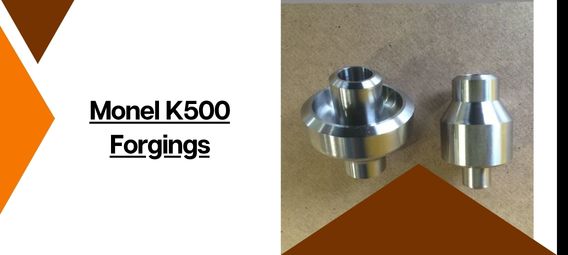
Choosing a forging material for high loads, corrosive fluids, and pressurized service affects how long a component performs reliably. Monel K500 Forgings and Stainless Steel Forgings are both used across marine, offshore, and chemical processing applications, but they offer different combinations of strength, corrosion resistance, temperature performance, availability, and cost. Corrosion Resistant Monel K500 Forgings are particularly suited to seawater and chloride-rich environments where some stainless steel grades may be susceptible to pitting or stress corrosion cracking. Stainless steel covers a much wider range of general industrial applications, often at a lower material cost. The comparison below covers composition, properties, corrosion behavior, applications, and material selection considerations.
What Are Monel K500 Forgings?
Monel K500 is a nickel-copper alloy that is age-hardened through heat treatment, with aluminium and titanium additions that increase its tensile and yield strength compared with Monel 400. Its designation, UNS N05500 Forgings, is commonly used in material specifications and certification. Forging provides a controlled grain structure and can improve mechanical consistency and fatigue performance when properly processed. Common Monel K500 Forged Components include pump shafts, gears, valve stems, fasteners, and other highly loaded parts used in corrosive environments.
What Are Stainless Steel Forgings?
Stainless Steel Forgings start as billets or other wrought stock that are shaped under compressive force. Controlled forging can refine the grain structure and produce consistent mechanical properties. Grade 304 provides general corrosion resistance, 316 adds molybdenum for improved chloride resistance, 410 provides higher hardness and wear resistance, and 17-4 PH offers precipitation-hardened strength for high-load applications. Performance varies significantly by grade and heat-treatment condition.
Key Properties of Monel K500 Forgings
- Tensile strength can reach approximately 1,200 MPa depending on product condition and specification; yield strength can reach approximately 700–830 MPa.
- Strong resistance to chloride-related corrosion and stress corrosion cracking in suitable environments.
- Reliable performance in seawater and marine atmospheres.
- Good resistance to erosion, cavitation, and wear in suitable rotating-part applications.
- Good dimensional stability across changing service temperatures.
Key Properties of Stainless Steel Forgings
- Corrosion resistance ranges from moderate in grades such as 410 to high in grades such as 316L, depending on the environment.
- Strength and toughness can be tailored to structural, pressure-containing, and highly loaded components through grade and heat-treatment selection.
- Temperature performance varies significantly by grade, ranging from cryogenic applications to elevated-temperature service.
- Wide availability, standardized grades, and established fabrication methods.
Corrosion Resistance Comparison
Monel K500 provides strong corrosion resistance in seawater and many chloride-containing environments, making it suitable for marine and offshore components. Its nickel-copper composition provides good resistance to corrosion in many marine conditions, although performance still depends on temperature, flow velocity, contaminants, and exposure conditions. Stainless steel performance varies considerably by grade. Grade 316/316L generally performs well in many corrosive environments, but its resistance to pitting and crevice corrosion can decrease as chloride concentration and temperature increase. Selection should therefore account for the actual chemical composition, concentration, temperature, flow conditions, and exposure duration rather than relying on a generic material category.
Strength and Mechanical Performance
Monel K500 can provide substantially higher strength than many conventional stainless steel grades, particularly in its age-hardened condition. Its fatigue performance also depends on the alloy condition, forging quality, component design, and loading conditions. Monel K500 Forged Parts are therefore considered for applications where high mechanical strength must be combined with corrosion resistance. Precipitation-hardened stainless steels such as 17-4 PH can provide high strength as well, making them an alternative when their corrosion resistance and service conditions are suitable.
Applications of Monel K500 Forgings
- Marine engineering uses it for propeller shafts, coupling components, and other highly loaded hardware.
- Offshore platforms use Monel K500 Forged Parts for subsea fasteners and components exposed to seawater.
- Pump and valve manufacturers use it for stems and components operating in corrosive fluids.
- Chemical processing equipment can use it for selected components exposed to corrosive media.
- Naval vessels use it for shaft components, while oil-well equipment can use it where mechanical loading and corrosive fluids occur together.
Applications of Stainless Steel Forgings
- Food processing equipment uses 304 and 316 for components requiring corrosion resistance and easy cleaning.
- Chemical plants specify forged stainless fittings for applications where the selected grade provides adequate corrosion resistance.
- Power plants use suitable stainless grades in high-temperature equipment and pressure-containing assemblies.
- Construction projects use stainless steel forgings for structural connectors and highly loaded components.
- Oil and gas systems use stainless steel components where the selected grade is suitable for the operating environment.
- Automotive manufacturers use 17-4 PH and other precipitation-hardening stainless steels for selected high-strength components.
- Water treatment plants use stainless steel valves and fittings in applications involving treated or chlorinated water.
How to Select the Right Forging Material
- Identify the Operating Environment: Determine whether the component will be exposed to seawater, chlorides, chemicals, humidity, or other corrosive conditions.
- Evaluate the Corrosive Media: Consider the chemical composition, concentration, temperature, flow velocity, and expected exposure duration.
- Determine Mechanical Requirements: Calculate pressure ratings, mechanical loads, fatigue cycles, impact requirements, and wear conditions.
- Define Material and Component Requirements: Establish the required tensile strength, yield strength, hardness, toughness, dimensions, and heat-treatment condition.
- Check Applicable Standards: Verify relevant ASTM, ASME, API, or other standards and confirm that the selected material meets the required specification.
- Verify Certification and Traceability: Request material certification, heat-number traceability, chemical analysis, mechanical test results, and other required inspection documentation.
- Consider Cost and Availability: Balance material cost, availability, manufacturing lead time, machining requirements, and expected service life.
Conclusion
Monel K500 Forgings and Stainless Steel Forgings address different engineering requirements, and the appropriate choice depends on the conditions a component will face. Monel K500 is particularly suited to marine propulsion, offshore fasteners, and chloride-rich environments where high strength and corrosion resistance are both required. Stainless steel, spanning grades from 304 to 17-4 PH, provides a broader range of options for industrial applications with different strength, corrosion, temperature, and cost requirements. Engineers should evaluate operating conditions, mechanical loads, corrosion exposure, component requirements, and applicable standards before selecting the forging material.