
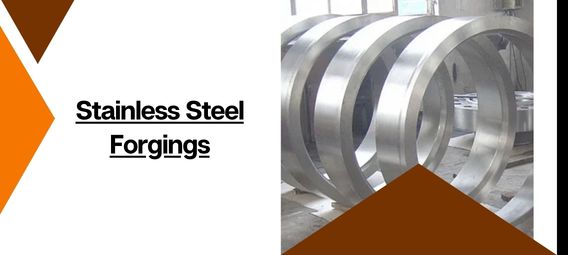
Oil and gas operations run equipment through pressures above 10,000 psi, temperatures swinging from arctic wellheads to flare-adjacent piping, and fluid streams loaded with hydrogen sulfide and chlorides. Few materials maintain long-term performance under these combined conditions, which is why stainless steel forgings are widely used for manufacturing critical components across the sector. Oilfield stainless steel forgings deliver the strength and corrosion resistance that cast or fabricated alternatives cannot consistently match under sustained pressure cycling. This blog covers why stainless steel forged components matter in oil and gas operations and where they get used across the production chain.
What Are Stainless Steel Forgings?
A stainless steel forging starts as a solid billet, heated above its recrystallisation temperature and shaped under compressive force from a hydraulic press or hammer. That working closes internal voids and aligns the grain flow along the part geometry, producing a denser, more fatigue-resistant structure than casting achieves. Cast components form from molten metal and are susceptible to microporosity which can cause failure when cyclic loads are applied; forged components do not have this problem as the metal remains in a plastic state during the manufacturing process. Common grades include 304/304L for ordinary service, 316/316L for chloride resistance and duplex 2205 for higher strength with better resistance to pitting. The cost of forging parts is usually higher than casting, but the increased expense is often compensated by the extended service life and reduced danger of unplanned shutdowns.
Why the Oil and Gas Industry Relies on SS Forgings
Mechanical strength in forged 316 stainless commonly reaches 80 ksi tensile, and duplex 2205 forgings push past 90 ksi, both well above cast equivalents of the same grade. Corrosion resistance from the chromium oxide layer holds up against produced water, brine, and sour gas containing hydrogen sulfide. Pressure ratings on forged flanges and fittings routinely support 10,000 to 15,000 psi service in high-pressure wellhead applications. Toughness stays consistent from sub-zero Arctic conditions up through elevated refinery process temperatures without the brittleness that can develop in lower-quality castings. Reliable performance under these combined stresses is exactly why API and ASME specifications default to forged construction for pressure-critical parts. That reliability directly lowers the risk of the kind of component failure that shuts down a production line or triggers an environmental incident.
Key Benefits of Stainless Steel Forged Components
Structural integrity improves because forging eliminates the porosity and inclusions that weaken cast parts under load. Fatigue resistance rises too, since continuous grain flow around a bolt hole or flange radius resists crack initiation far better than a casting’s random grain structure. Service life on forged flanges and valve bodies in continuous oilfield service commonly exceeds 20 years with proper maintenance. Wear and corrosion resistance stay high across the alloy’s service range, particularly in 316L and duplex grades exposed to produced brine. High-temperature performance holds up in refinery units running above 500°F, and maintenance intervals stretch out because fewer components need premature replacement.
Common Components Used in Oil & Gas
Flanges connecting pipeline sections and pressure vessels. Valves controlling flow in wellhead and gathering systems. Fittings join piping runs across refineries and offshore platforms. Shafts inside pumps and compressors handle continuous rotational load. Couplings linking drive systems in rotating equipment. Rings used in pressure vessels and turbine assemblies. Connectors for subsea and topside piping systems. Pressure vessel components including nozzles and manways. Pump and compressor parts are exposed to abrasive or corrosive process streams.
Applications of SS Forgings in the Oil and Gas
Offshore drilling platforms depend on forged stainless components for wellhead assemblies and riser connections exposed to constant saltwater spray. Onshore drilling operations use forged fittings and valve bodies across wellhead trees and manifold systems. Refineries and petrochemical plants specify forged flanges and nozzles for units handling sour crude and high-temperature process streams. Pipeline systems rely on forged flanges at every major connection point to maintain pressure integrity over decades of service. Pressure vessels use forged nozzles and heads where a weld failure would be catastrophic. Heat exchangers built with forged tube sheets resist the erosion-corrosion that shell-and-tube designs generate at high flow velocities. Pumps and compressors run forged shafts and casings in continuous service. LNG and gas processing facilities specify low-temperature forged grades for cryogenic piping and vessel connections.
Factors to Consider When Selecting SS Forgings
There are several factors to consider when trying to select the best stainless steel forgings for long-term mechanical reliability. First and foremost, the selected material grade must meet the operating pressure and temperature limitations of the component. Exposure to a corrosive environment decreases the likelihood of premature failure. Industry regulations and certifications offer the advantage of full traceability. Tight dimensional tolerances and stringent quality testing and inspection processes provide structural integrity even in severe operating environments.
Conclusion
Stainless steel forgings hold oil and gas operations together at the points where failure carries the highest cost: wellheads, pipelines, refineries, and offshore platforms running under extreme pressure and corrosive exposure. Their resistance to pressure, corrosion, and harsh operating conditions comes directly from the forging process itself, not just the alloy composition. Stainless steel forged components keep production running safely, and sourcing them through a supplier like Renine Metalloys gives operators access to grades tested against the exact standards this industry demands.