
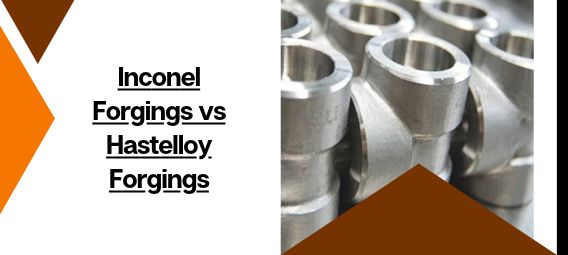
Chromium and molybdenum play different roles in nickel alloy performance, influencing oxidation resistance, corrosion resistance and high-temperature strength. This distinction helps explain why Inconel and Hastelloy forgings serve different industrial requirements. Inconel and Hastelloy belong to the broader category of nickel alloy forgings, alongside materials such as Monel 400 forgings. However, their alloy compositions give them different strengths across high-temperature and corrosive service conditions. Inconel carries high chromium and holds strength in hot oxidizing gas. Hastelloy carries high molybdenum and survives wet acid attack that eats chromium-rich alloys. Choosing the wrong family costs more than the price difference, because a premature material failure takes the equipment and the production schedule with it.
What Are Inconel Forgings?
Inconel forgings are manufactured from nickel-based alloys containing chromium and other alloying elements. Depending on the grade, these materials provide oxidation resistance, corrosion resistance and mechanical strength at elevated temperatures. Chromium forms a tight oxide scale on the surface, and that scale is what blocks further attack in hot air, steam, and combustion gas.
Strength at temperature separates this family from austenitic stainless steel. Inconel 600 resists oxidation up to around 1095°C in air. Inconel 625 adds 8 to 10% molybdenum and 3.15 to 4.15% niobium, which lifts strength through solid-solution hardening without heat treatment. Inconel 718 takes a different route entirely: it precipitation-hardens during ageing and reaches tensile strength above 1240 MPa in the aged condition, which makes it the standard choice for turbine discs and high-load fasteners up to roughly 700°C.
Common forged grades run to Inconel 600, 625, and 718.
What Are Hastelloy Forgings?
Hastelloy forgings are designed primarily for demanding corrosion environments, particularly those involving acids, chlorides and aggressive chemical solutions. Certain grades also retain useful mechanical properties at elevated temperatures. The family loads nickel with molybdenum, which resists reducing acids and pitting in chloride solutions far better than chromium alone manages.
Aggressive chemical environments are where these alloys earn their cost. Hastelloy C-276 carries 15 to 17% molybdenum with 14.5 to 16.5% chromium and 3 to 4.5% tungsten, and it handles wet chlorine, hypochlorite, ferric chloride and mixed acid streams. C-22 shifts the balance toward chromium at 20 to 22.5% with 12.5 to 14.5% molybdenum, which broadens its range across both oxidising and reducing conditions. B-2 pushes molybdenum to 26 to 30% with chromium held under 1%, aimed squarely at hydrochloric and sulphuric acid where no chromium is wanted at all.
Common forged grades run to Hastelloy C276, C22 and B2.
Inconel Forgings vs Hastelloy Forgings: Key Differences
| Factor | Inconel forgings | Hastelloy forgings |
| Primary alloying driver | Chromium, 14 to 23% | Molybdenum, 12.5 to 30% |
| Design strength | High-temperature strength and creep resistance | Wet corrosion resistance |
| Oxidation in hot gas | Resists scaling to around 1095°C (grade 600) | Lower practical ceiling |
| Acid resistance | Moderate in reducing acids | Handles hydrochloric and sulphuric acid |
| Chloride pitting | Good in grades carrying molybdenum | Stronger across the family |
| Hardening route | Solid solution, or precipitation in 718 | Solid solution only |
| Typical ceiling | Up to 700°C structural in 718 | Mostly wet service below 400°C |
Chromium and molybdenum pull in different directions. Chromium builds the oxide film that defends against hot gas, while molybdenum defends against the chloride and acid attack that breaks that film down in solution. Hastelloy B-2 deliberately excludes chromium because chromium accelerates attack in strong hydrochloric acid.
Fabrication differs too. Both families work-harden during forming, but Inconel 718 needs a controlled solution-and-age cycle after forging to reach its rated properties. Hastelloy grades take a solution anneal and a rapid quench, since slow cooling precipitates carbides at the grain boundaries and strips corrosion resistance.
Industrial Applications of Inconel Forgings
Aerospace builds turbine discs, shafts, rings and fasteners from Inconel 718 forgings. Power generation uses 625 and 600 in gas turbine components, steam service hardware and combustion parts. Oil and gas specifies 625 forgings for sour service wellhead components and downhole tooling.
Chemical processing draws on the family for high-temperature equipment where oxidising conditions prevail. Forged shafts, flanges, rolled rings, valve components and pressure equipment parts all appear in these grades.
Industrial Applications of Hastelloy Forgings
Chemical processing plants install C-276 forgings in reactor components, heat exchanger parts, valve bodies and pump casings handling acid and chloride streams. Pollution control uses the alloy in flue gas desulphurisation scrubbers, where wet acidic condensate attacks lesser materials.
Pharmaceutical manufacturers specify C-22 for reactor and piping components demanding product purity and resistance to cleaning chemicals. Marine applications cover pump shafts, valve trim, fittings and fasteners in seawater and brine. At Renine Metalloys we supply forged blanks in these grades to fabricators building exactly this equipment.
How to Choose Between Inconel and Hastelloy Forgings
Start with temperature. Above 500°C in oxidising gas, Inconel leads. Below 400°C in wet acid or chloride solution, Hastelloy leads.
Identify the corrosive species and its concentration next. Hydrochloric acid points toward B-2. Mixed acids, wet chlorine or ferric chloride point toward C-276. Hot combustion gas or steam points toward 600 or 625.
Check the mechanical requirement against the service. Rotating or highly loaded parts may need the aged strength of 718, which no Hastelloy grade matches. Then confirm the fabrication route, the applicable ASTM or ASME specification, the heat treatment condition and the size availability before committing, since forging stock in large sections carries longer lead times.
Conclusion
Inconel forgings and Hastelloy forgings differ on one axis that matters most: Inconel uses chromium to hold strength and resist oxidation in heat, while Hastelloy uses molybdenum to resist acid and chloride attack in solution. Temperature, media chemistry and mechanical load decide which family fits.
No single grade covers both duties, so the correct choice follows the operating environment, the specific alloy grade and the equipment requirements. Share your service conditions for a grade recommendation with temperature, media and section size specified.