
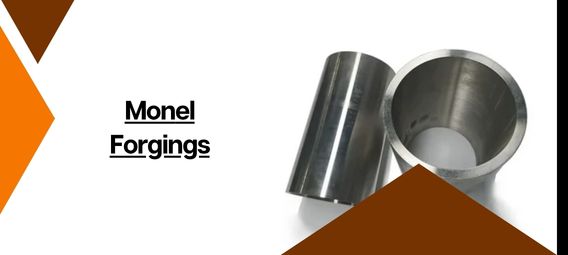
Corrosive service conditions can significantly reduce the service life of standard steel components. Offshore platforms, chemical plants, and desalination units push pumps, valves, and fasteners through seawater exposure and constant pressure cycling that ordinary alloys rarely survive long term. Monel forgings address this challenge through a nickel-copper alloy designed for excellent corrosion resistance in environments where many conventional materials struggle. nickel copper alloy forgings combine tensile strength with chemical resistance in one forged component, and the forging process refines the grain structure enough to survive repeated stress cycles without cracking. This blog looks at how Monel alloy forgings perform inside pumps, valves, and fasteners across demanding industrial environments.
What Are Monel Forgings?
Monel forgings start as a nickel-copper alloy, typically 63 to 70 percent nickel and 28 to 34 percent copper, with small iron and manganese additions depending on grade. A heated billet gets worked under a hammer or press, and that compressive force aligns the grain flow along the shape of the part. Cast Monel solidifies from a liquid state and can trap porosity inside the part; forged Monel skips that risk since the metal never fully liquefies. Monel 400 covers general corrosion-resistant applications, while Monel K-500 adds aluminum and titanium for age-hardening, roughly doubling the yield strength of standard Monel 400.
Key Properties of Monel Alloy Forgings
Corrosion resistance tops the list, particularly against seawater and alkaline solutions that pit carbon steel within one operating season. Yield strength for forged Monel 400 runs 25 to 45 ksi, and forged K-500 reaches 90 to 100 ksi after heat treatment. Toughness holds up from cryogenic temperatures near -100°F through service near 900°F, a combination rarely found within a single alloy family. Nickel content gives Monel forgings solid resistance to non-oxidizing acids. Components in continuous marine service commonly run 15 to 20 years before replacement, well beyond carbon steel.
Why Monel Forgings Are Used in Pump Manufacturing
Pump shafts, impellers, and housings sit in constant contact with the fluid being moved, and pitting or crevice corrosion on a rotating shaft leads to seal failure fast. Monel forgings resist attack from brine, seawater, and dilute sulfuric acid. Continuous operation adds fatigue loading on top of chemical exposure, and the forged grain structure handles that cyclic stress better than cast alternatives. Desalination plants and offshore injection pumps rely on Monel shafts because saltwater exposure never lets up during a multi-year run. Fewer corrosion failures mean less unplanned downtime, which matters most where a pump swap halts production for days.
The Role of Monel Forged Components in Valve Manufacturing
Valve bodies, stems, discs, and seats built from Monel forgings hold up under pressures that routinely exceed 6,000 psi in offshore choke and control valve service. The same seawater and acid resistance protecting pump components protects valve internals from erosion at high flow velocities. Sealing performance depends on dimensional stability under pressure, and forged Monel resists the deformation that opens a leak path at the seat. Chemical plants specify Monel stems and trim for hydrofluoric acid alkylation service, where few other metals survive extended contact. Offshore control valves under both actuation stress and saline atmosphere depend on this combination to avoid repeated shutdowns.
Industries That Rely on Monel Forged Components
Marine and shipbuilding operations use Monel forged fittings on hulls and propeller shaft systems exposed to constant saltwater. Oil and gas producers specify Monel for subsea trees and wellheads where hydrogen sulfide attacks lesser alloys. Chemical plants depend on Monel valve trim for hydrofluoric acid units. Petrochemical refineries use forged Monel in heat exchanger components handling caustic streams. Power generation facilities specify it for feedwater hardware. Desalination plants build reverse osmosis pump components from Monel almost exclusively. Aerospace and defense manufacturers use Monel fasteners in fuel system applications where weight, strength, and corrosion resistance matter together.
Benefits of Using Monel Forged Components
Resistance to seawater, acids, and alkalis extends component life well beyond carbon steel. Mechanical properties stay stable across a range spanning roughly 1,000°F, which few nickel alloys match. That reliability reduces unplanned maintenance, and fewer shutdowns lower total cost of ownership despite higher upfront material cost. Equipment lifespan commonly extends by a decade or more in marine service. Operational safety improves too, since a valve stem or pump shaft failing under pressure creates a real hazard offshore, and Monel forgings cut that failure mode by resisting the corrosion that triggers it.
Factors to Consider When Selecting Monel Forgings
Match the grade to the application first: Monel 400 for general corrosion resistance, K-500 where higher strength matters. Operating temperature and pressure define the wall thickness and forging tolerances required. Exposure to specific media, whether seawater or caustic solutions, changes which variant performs best. Component dimensions need to match mating equipment exactly, particularly for valve seats and pump shaft fits. Standards such as ASTM B564 and ASME B16.34 govern acceptable forging practices for pressure-retaining parts. Quality testing, including ultrasonic inspection, confirms the forging meets specification before it ships.
Conclusion
Monel forgings solve a real problem in pump, valve, and fastener manufacturing: standard alloys corrode too fast in seawater and high-pressure service, making replacement cycles expensive and disruptive. The corrosion resistance, strength, and reliability built into forged Monel components keep offshore platforms and marine vessels running with fewer unplanned shutdowns. Manufacturers sourcing forged Monel components through Renine Metalloys get access to grades tested against the standards these industries require, supporting equipment that performs safely across decades of service.